How to Run a Spelling Bee: A Guide for Teachers and Schools
The format, words, roles, rules, ties and timing for a class or school bee, with a day-of checklist. All of it works with a printed word list and a pencil.

To run a spelling bee, choose a format, pick words by grade or year group, and give each adult a job: a pronouncer to read the words, one to three judges to rule on each answer, and a record keeper to track who is still in. Share the rules before you start. Each speller hears a word, may ask to hear it again or for its meaning or a sentence, and spells it aloud. A miss usually means going out at the end of the round, and the last speller must spell one more word, the championship word, to win. Allow 30 to 45 seconds a turn, so the first round with 26 spellers takes 15 to 20 minutes.
The rest of this guide takes those steps one at a time. It is written for teachers, and also works for parent volunteers and clubs. Where it says grade and students, UK and Australian teachers can read year group and pupils.
Is your school in an official program? If it is enrolled in one, such as the Scripps National Spelling Bee in the US or the NSW Premier's Spelling Bee in Australia, follow that program's rules and word lists. They come first. This guide is for class and school bees you organize yourself, and SpellCrush is not affiliated with any official program.
1. Decide the format
The format decides how long the bee takes and how many children are sitting out by the end. Pick it first, because everything else follows from it.
| Format | How it works | Best for |
|---|---|---|
| Classic elimination | Spellers take turns. A miss means going out at the end of the round, and the last speller in wins. | Finding one winner. School bees, finals, older classes. |
| Two mistakes | The same, but a speller goes out on their second miss. | A first bee or a younger class. It takes longer. |
| Team bee | 2 to 4 teams take turns, with a point for each correct word. A missed word can be stolen by the next team. Stop after a set number of rounds. | Keeping the whole class in for one lesson. Nobody is knocked out. |
| Written round, then a final | Everyone writes the same 20 or 25 words on paper. The top 8 to 10 spell aloud at the front. | Large classes, whole grades, and children who dread speaking in front of others. |
With one lesson and a class of 26, a full elimination bee is tight. Use a team bee, or hold a written round and run the final with the top 8 to 10.
2. Choose words by grade or year group
Start from what the class has already been taught. The first round should feel winnable, and the words should get harder each round. This table matches children of the same age across the three systems, and each link opens a word list for that level.
| Age | US grade | UK year | Australian year | Words to draw on |
|---|---|---|---|---|
| 5-6 | Kindergarten | Year 1 | Foundation | Sight words, word families, number and color words |
| 6-7 | 1st grade | Year 2 | Year 1 | Short vowel words, blends, digraphs, sight words |
| 7-8 | 2nd grade | Year 3 | Year 2 | Long and r-controlled vowels, suffixes, compound words |
| 8-9 | 3rd grade | Year 4 | Year 3 | Prefixes, homophones, Latin roots |
| 9-10 | 4th grade | Year 5 | Year 4 | Greek roots, harder suffixes, irregular plurals |
| 10-11 | 5th grade | Year 6 | Year 5 | Latin roots, absorbed prefixes, science vocabulary |
| 11-12 | 6th grade | Year 7 | Year 6 | Greek and Latin roots, middle school vocabulary |
| 12-13 | 7th grade | Year 8 | Year 7 | -cede, -ceed and -sede words, /shun/ endings |
| 13-14 | 8th grade | Year 9 | Year 8 | Latin verb roots, -ance and -ence, affect and effect |
- Have enough words. Plan for about three words per speller, plus spares. A bee with 26 spellers uses about 70 words if a third go out each round, so have 100 ready.
- Put them in order. Fix the order before the day, easiest first, so nobody can say a child got an unfair word. Keep the hardest few back for the final and any tiebreak.
- Write out the meaning and a sentence. The pronouncer needs both for every word. A word that sounds like another (pair, pear) always needs its sentence.
- Decide about a study list. Many class bees hand out a list a week or two before and draw the early rounds from it. Keep a few unseen words for the final.
- Settle the spelling standard. Say in advance whether you accept both British and American spellings (colour and color). This matters in international schools and mixed classes.
For a printable list by grade and difficulty, try the spelling bee word generator. For harder rounds, use the commonly misspelled words or the hardest words to spell. There is more on pitching the level in spelling bee words by grade level.
3. Give everyone a role
- Pronouncer. Reads each word exactly as it is on the list, and gives the meaning and sentence when asked. Practices the hard words beforehand, keeps the same pace for every child, and shows no reaction to the answer.
- Judges (one to three). Follow the word on paper, listen to each letter and rule correct or incorrect. Use an odd number so there is always a majority. Their decision is final.
- Record keeper. Writes down each speller, word and result, tracks who is still in and marks the next word. This record settles any dispute later.
- Timekeeper (optional). Runs the clock if you use a time limit.
- Speller helper (school bees). Lines spellers up in order and keeps them calm off stage.
On your own in a classroom? Pronounce and judge yourself, and ask a teaching assistant, colleague or parent helper to keep the record. It is very hard to do all three at once and still listen to every letter.
4. Teach the speller procedure
Show the class what a turn looks like, then run one practice round with easy words, so nobody's first time at the front is the real thing.
- Come to the front when called, and face the pronouncer.
- Listen to the word.
- Ask, if needed, to hear it again, or for its meaning or a sentence.
- Say the word (encouraged, not required).
- Spell it aloud, one letter at a time.
- Say the word again (encouraged, not required).
- Wait for the judge. Correct: back to your seat. Incorrect: hear the right spelling, and go back to your seat.
Formal bees often let spellers ask for the language of origin and the part of speech too. In a class bee you can leave those out.
5. Set the rules and read them aloud
These are the classic elimination rules, adapted for a classroom or school. Change what you need to, but write the rules down and read them out before the first word.
- The turn order is drawn at random and shown to everyone.
- Each speller gets one word a turn, the next on the list.
- A speller may stop and start again, but may not change letters already said or their order.
- One miss and you are out, or two for a younger class. Say which before you start.
- Nobody sits down until the round is over. If everyone left in a round misses, everyone stays in.
- If the pronouncer makes a mistake or the speller was given the wrong word, the speller gets a new word with no penalty.
- Time limit (optional): 30 or 60 seconds a word, starting when the word is first read.
- No help from the audience. Everyone gets a clap.
- The judges' decision is final. Any question must be raised by an adult before the next speller starts.
6. Handle ties and the last speller
Disagreements tend to come at the end of a bee, so decide this part in advance and include it in the rules you read out.
- Everyone left misses in the same round: they all stay in, and the next round starts.
- One speller is left: they must spell one more word, the championship word, to win.
- They miss the championship word: the spellers who went out in that round come back, and the bee carries on.
- Runner-up: the last speller to go out. If several went out in that round, they can share second place or spell off for it.
- Time or words run out: give the remaining spellers the same few hard words on paper. The most correct wins. If that is also a tie, share the title.
- Team bee tie: one sudden-death word per team.
7. Plan the timing
Allow 30 to 45 seconds a turn, including walking to the front. The whole-bee figures below assume about a third of the spellers go out each round, so easy words will make the bee run longer. Add five minutes for the rules and a practice round.
| Spellers | First round | Whole elimination bee |
|---|---|---|
| 10 | 5 to 8 minutes | About 15 to 20 minutes |
| 20 | 10 to 15 minutes | About 30 to 45 minutes |
| 26 | 15 to 20 minutes | About 35 to 55 minutes |
| 30 | 15 to 23 minutes | About 45 to 65 minutes |
Running behind? Move to the harder words sooner. That is fairer than cutting the bee off, because every remaining speller still gets the same chance.
8. From class bee to school bee
Many schools run a bee in each class first, then bring the best spellers together. A simple way to do it:
- Agree one rule sheet and a date range with the other teachers, so every class chooses its spellers the same way.
- Run the class bees in the same week or two, each with words for its own grade or year group.
- Send the top two from each class, the winner and the runner-up, to the school bee. With many classes, use a written round to narrow each grade down further.
- Run the school bee in the hall or auditorium with a microphone. Ask someone other than the spellers' own teachers to pronounce and judge. If the ages are mixed, run separate lower and upper divisions, or start with easier words and let them get harder each round.
- Going further? If your school's winner can go on to a regional or national bee through an official program, check its rules before the class bees start. It may set the dates, the word lists and who can take part.
9. Keep every child involved
In a class of 26, one child spells while 25 wait, and the wait gets longer for anyone who is out. These habits keep the whole room spelling.
- Write along. While one child spells aloud, everyone else writes the word on a mini whiteboard or paper and checks it when the answer is given. Children who are out keep going, and you can give a small prize for the best written score.
- Give out jobs. Children who are out can keep a tally of correct words or hold up the round number.
- Keep a miss gentle. Skip the buzzer. Say "good try", give the right spelling and thank the child by name.
- Plan for children who find this hard. A written round, a study list in advance or a second chance helps children with dyslexia, children still learning English and anyone anxious about speaking in front of others. Taking part at the front can also be a choice.
Day-of checklist
The day before
- Print the word list in order, with each word's meaning and sentence: one copy each for the pronouncer, the judges and the record keeper
- Set aside spare words and the championship words
- Print the rules and the record sheet
- Draw the turn order and make number cards if you are using them
Before the spellers come in
- Set out chairs for the spellers, and a spot at the front to stand
- Seat the pronouncer and judges where they can hear every letter
- Test the microphone, or the screen and its sound
- Put out mini whiteboards, pens and cloths for the write-along
- Have a timer, water and the prizes or certificates ready
Before the first word
- Read the rules aloud and take questions
- Say which spellings you will accept
- Run one practice round with easy words that don't count
- Tell the audience there is no helping, and that everyone gets a clap
Afterwards
- Thank every speller, and announce the winner and runner-up
- Keep the record sheet, in case of questions
- Turn the missed words into next week's practice list
- Send the names of anyone going on to the next bee
Running it on the big screen
Everything above works on paper. If you would rather not be the pronouncer, judge and record keeper all at once, the SpellCrush Class Spelling Bee does the reading and the record keeping while you judge. It is free to start, with no sign-up. It runs in one room, with the class watching one screen, so children don't need devices.
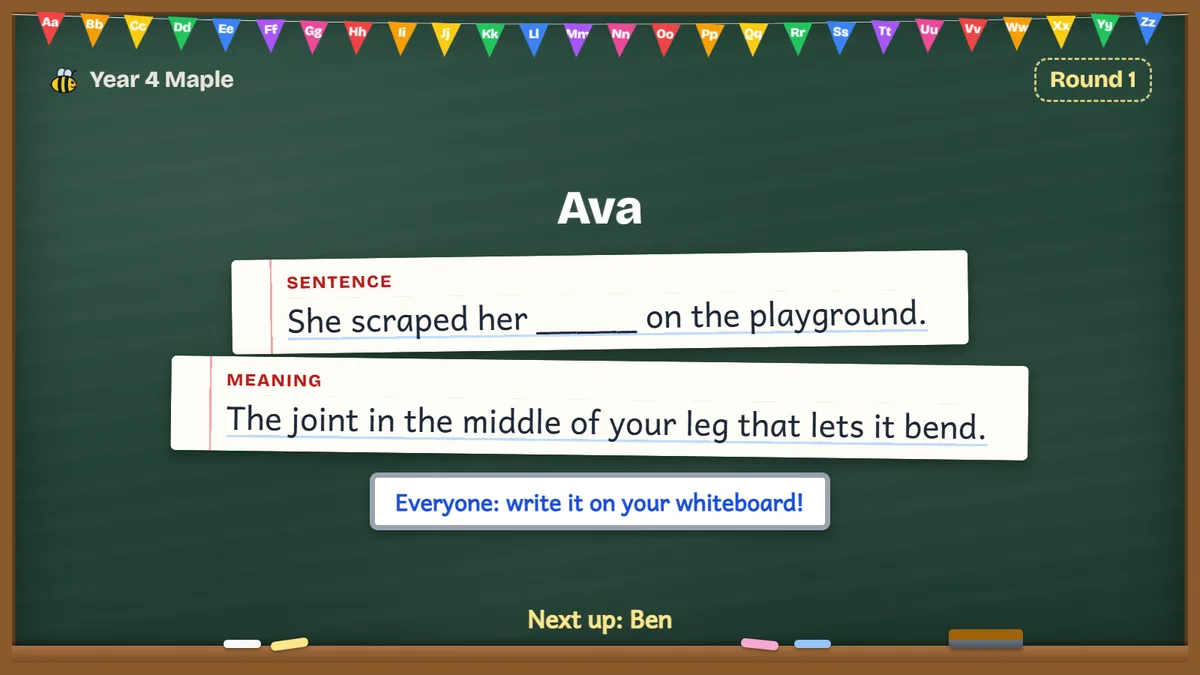
- Set it up on your phone, tablet or laptop. Type your spellers' first names and pick a ready-made list by grade or year group, such as 4th grade or Year 4. It takes about two minutes, and tells you how many rounds your words will last.
- Put it on the big screen. On a smartboard, interactive whiteboard, TV or projector, or any screen with a web browser, open spellcrush.fun/board. There is no login on the board. Type its code on your phone or scan its QR code. One laptop on a projector also works.
- Run each turn from your phone. Tap to give the word. A recorded voice reads it with its meaning and a sentence (any word without a recording uses your browser's voice, and the setup tells you how many have one). Tap Correct or Incorrect, and the board shows the right spelling so the class can check their whiteboards.
- Keep the record. Print the word sheet as your pronouncer's list, and download the results as a CSV or PDF afterwards.
Its Classic bee follows the rules in this guide: 1 or 2 mistakes, nobody sits down until the round is over, and a championship word at the end. See the class spelling bee rules and the step-by-step guide with screenshots.
What it costs
| No account | Free account | Premium | |
|---|---|---|---|
| Spellers | Up to 10 | Up to 20 | Up to 40 |
| Ready-made word lists | 1 | 3 | 8 |
| Your own words | - | - | Up to 100 |
| Certificates | - | - | Yes |
| Missed-words practice list | - | - | Yes |
A full class of 26 is more than the 20 spellers a free account takes, so either run a written round first and bring your finalists to the board, or use Premium (up to 40 spellers). The board, phone remote, word sheet, write-along and results download come with every level. See Premium.
Team bee is part of tutor accounts, and those aren't open to new sign-ups at the moment. To run a team format today, use the paper version from step 1.
Frequently asked questions
How do you organize a spelling bee at school?
Choose a format, pick words by grade or year group, and give each adult a job: a pronouncer, one to three judges and a record keeper. Share the rules and a study list a week or two ahead. Run a bee in each class first, then send the top two spellers from each class to the school bee.
Who do you need to run a spelling bee?
A pronouncer who reads each word, its meaning and a sentence, one to three judges who decide whether each spelling is right, and a record keeper who tracks each word and who is still in. In a classroom one teacher can pronounce and judge, as long as someone else keeps the record.
How long does a spelling bee take?
Allow 30 to 45 seconds a turn. The first round with 26 spellers takes 15 to 20 minutes. If about a third of the spellers go out each round, a whole bee with 26 spellers takes about 35 to 55 minutes.
How many words do you need for a spelling bee?
Plan for about three words per speller, plus spares. A bee with 26 spellers uses about 70 words if a third go out each round, so have 100 ready.
What are the basic rules of a spelling bee?
Turn order is drawn at random. Each speller hears a word, may ask to hear it again or for its meaning or a sentence, then spells it aloud. A speller may start again but may not change letters already said. A miss usually means going out at the end of the round. If everyone left in a round misses, everyone stays in.
How do you break a tie in a spelling bee?
If everyone left in a round misses, they all stay in and spell again. When only one speller is left, they must spell one more word, the championship word, to win. If they miss it, the spellers who went out in that round come back. If time runs out, give the remaining spellers the same few hard words on paper, and the most correct wins. In a team bee, use one sudden-death word per team.
How do you keep the other children involved during a spelling bee?
Have the whole class write each word on a mini whiteboard while one child spells it aloud, then check it when the answer is given. Children who are out keep writing. A team format also works, because nobody is knocked out.
Do these rules apply to official spelling bees?
No. This guide is for class and school bees you organize yourself. If your school is enrolled in an official program, follow that program's rules and word lists. SpellCrush is not affiliated with any official spelling bee program.
Can I run a spelling bee on a smartboard or interactive whiteboard?
Yes. The SpellCrush Class Spelling Bee shows the bee on a screen with a web browser, such as a smartboard, interactive whiteboard, TV or projector, and you run it from your phone. It is free to start: a Classic bee for up to 10 spellers with no account, or 20 with a free account. Premium takes up to 40 spellers.
Run your class bee on the big screen
Set it up on your phone in about two minutes. Free to start, with no sign-up.


